Akagera national park found in eastern Rwanda is a 2500 sq km of mainly Savannah land. The park is named after Kagera River that flows along Rwanda’s eastern boundary with Tanzania. The river feeds into Lake Ihema and other smaller lakes in and around the park.
The Akagera National Park protects an African Savannah landscape of acacia and bush with patches of open grassland and a dozen swampy lakes. It has exceptional levels of biodiversity and forms a large protected wetland. Akagera national park is the only Savannah national park in Rwanda and the only place to sight most of the large mammals while on safari. Whereas there are forest elephants in the other parks, it is very difficult to sight them. Explore the park in the comfort of your safari vehicle while on a game drive.
Wildlife in Akagera National Park
Akagera national park is home to a variety of wildlife which include, elephants, buffalos, giraffe, zebras, leopards, hyenas, lions. It is home to several antelopes like bushbucks, Topis, Oribis, water-buck, roan antelope and duiker, klipspringer, impala and world largest antelope – the Cape eland.
You can watch schools of hippos and crocodiles basking in the sun near lake Ihema. The common primates in Akagera national park are olive baboons, Vervet monkeys, blue monkeys and bush babies who are often seen on night drives.
Birds in Akagera National Park
Akagera national park has a wide variety of habitats which provide great habitat for 500 bird species. The bird species to look out for include the remarkable shoebill, papyrus Gonolek, African Wattled Plover, Giant Kingfisher, Senegal Lapwings, Squacco Herons, African Open bill stock, Grey Crowned Crane, African Darter, Long-toed and Water Thick-knee.
More bird species likely to encounter are, fish eagles, Cattle Egret, Hamerkop, Sacred and Hadada Ibis, Augur Buzzard, Long-crested Eagle, and Pied Crow. Black-headed and Viellot’s Black Weavers, Grey-backed Fiscals, Fan-tailed Widowbird and Caruther’s Cisticola.
Game drives in Akagera National Park
Game drives in Akagera national park are done in safari vehicles starting early morning in search of the leopards, hyenas, and the re-introduced lions. This is because the predators prefer to hunt at night or early morning and usually go into hiding as the heat from the sun increases. Along the carnivores, enjoy the scenery of this beautiful park and several other big mammals like Elephants, buffaloes, antelopes, Zebra and Giraffes. The landscape and beautiful wild floweres will make for good pictures for the interested photographer.
There is also night game drives carried out by the park officials i.e. Akagera management company. These normally last about 2 hours starting from 6pm to 8.30pm in the night. You will have spotlight to help in watching the different nocturnal animals. You might have an opportunity of sighting the leopards as they hunt or even the lions.
Boat safari on Lake Ihema
The best way to spend an afternoon in Akagera national park is to take a boat ride on Lake Ihema. Most animals are hiding under shade because of the heat from the sun as others come to the water for cooling off and drinking. In addition to a variety of water birds, you will watch schools of hippos in the water and crocodiles by the shores of the lake. There are scheduled boat trips which happen during the day but one can book for a private unscheduled boat trip at their own timing.
Sport fishing in park
The park offers an opportunity of sport fishing on Lake Shakani. You are required to make a booking with the park for sport fishing on this lake. Even though the expectation is catch and release, you are given an opportunity to take one catch for a meal if interested.
Cultural tours near At Park
Experience the rural Rwandan life around the cattle keeping communities near Akagera national park. You have opportunity to observe and or participate in traditional cattle grazing, milking, traditional milk storage in calabashes for preservation. You then go through the process of converting milk into different products like traditional yogurt, ghee and lastly take part in preparing a meal with some of the ingredients from the milk products. This is an authentic cultural experience shared by the locals living adjacent to the park, they get to earn from this supplementing their agricultural income. This eventually contributes to conservation culture and wild animals in the park.
How to get to Akagera national park
You can drive from Kigali through Rwamagana town to Akagera national park (entrance is only through southern gate. Northern gate is currently used only for exit). The journey takes a total of about 2 hours to arrive at the park entrance.
There is an option of flying to the park using the services of Akagera Aviation for those not keen on the 2 hour drive.
Nyungwe forest national park is found in western Rwanda and is one of the worlds most beautiful and pristine rain forests. It is dominated by a series of mountains, originating in northern Uganda and Congo, running south through the Rwenzori mountains, western Rwanda and Burundi, to the shores of Lake Tanganyika.
Nyungwe forest national park offers scenic views over the Lake Kivu and sometimes the Virunga ranges on a clear day. The forest has an extensive network of well-maintained walking and hiking trails to various waterfalls and viewing points. The prime activities in Nyungwe forest are chimp trekking, bird watching, colobus monkey trekking and the canopy walk.
Animals in Nyungwe forest national park
Nyungwe National Park is home to 75 different species of mammals with most of these being small and or nocturnal making it difficult for sighting. Chimpanzees are the main attraction in nyungwe forest with chimp trekking happening daily early morning. The forest is home to troops of 300 colobus monkeys or more roaming in the trees, giving visitors to the forest another engaging activity.
Dent’s Mona Monkey, Blue Monkey, Angolan Colobus Monkeys
Birds in Nyungwe forest National Park
Nyungwe National Park is home to about 300 species of birds with 16 endemics, 27 Albertine rift endemics, and 121 forest species. The bird species include; Chestnut Owlet, Olive and Elliot’s Woodpeckers, Great Blue and Ruwenzori Turacos, White-headed Wood-hoopoe, Barred Long-tailed Cuckoo, , Stripe-breasted Tit, the remarkable Red-collared Babbler, Archer’s Robin Chat, White-bellied Robin Chat, Doherty’s Bush-Shrike, Handsome Francolin Mountain Masked, Black-faced, Chapin’s Flycatcher, Purple-breasted and Regal Sun-birds, Chestnut-throated, Collared Apalis, Rwenzori Batis, Neumann’s Short-tailed Warbler, White-tailed Blue-flycatcher, etc.
Activities in Nyungwe forest national park
Chimpanzee Trekking in Nyungwe National Park
Nyungwe National Park is home to two wild chimp communities that are habituated for chimpanzee tourism. One of the groups is in Cyamudongo section of Nyungwe forest and the other around the Uwinka area of the forest. The forest is home to about 400 chimpanzees. While viewing chimpanzees is not guaranteed, you will enjoy learning about these creatures and their natural habitats from your guides. You are expected to be at the briefing area as early as 5.00 am in the morning. This is because chimps are mostly likely to be seen early in the morning and they tend to move about which requires one to be active as you follow after them. However whether you view the chimps or not, the experience in the forest is rich as you watch other primates, butterflies, several trees and above all the freshness of the air.
Birdwatching in Nyungwe National Park
Nyungwe forest national park is a high altitude mountain forest ranging between 1600 – 2950 meters. The birds in Nyungwe forest are mostly found in the trees, shrubs or the ground at the edges of the forest next to the tea plantations. Some birds are shy and therefore more easily heard than seen like many forest birds. Among the frequently sighted species are the Rwenzori Nightjar, White-tailed Crested Flycatcher, Kivu Ground Thrush, the Handsome Francolin, Dwarf Honeyguide, Greatblue and Rwenzori Turaco, montane Double Collared Sun and the Red- Throated Alethe. There are well maintained trails which you will take while birding as well as trained bird guides that are based at the nyungwe forest.
Nature and hiking walks in Nyungwe forest
Nyungwe National Park has steep landscape and extensive network of hiking trails making it a perfect destination for hikers. The trails are different in length, ease of hiking and features; you are therefore advised to ask the ranger guides for advice on which trail to take according to the attractions you are seeking. The trails are through a diverse landscape and represent the most scenic way of exploring the forest. Below are some of the trails you can choose to take on while hiking in the forest
Congo – Nile divide trail is a 227 km trek for experienced hikers which lasts several days to hike through. However one can choose an option for one-day hike of part of the section. The main attraction on this trail is the varied landscapes and communities along the route. There are campsites where you will overnight but you do have to bring your own camping equipment. As for basic supplies, there are shops along the trail where you can purchase these.
The Igishigishigi trail covers a distance of 2km with remarkable views of the Nyungwe forest canopy, beautiful wild flowers, occasional monkeys and several birds. The total time on this trail is between one and two hours depending on ones interests. All participants must be at least six years of age and adults must acompany children.
Karamba trail is a good birding spot in Nyungwe, which is flanked by numerous fern trees located on the former gold mine site, market and army camp.
Umugote trail is great for primate viewing and bird watching in Nyungwe forest with views of ridges, flowers, and butterflies. On a clear day you can see Kibira national park in Burundi.
Umoyove trail also known as Mahogany trail takes you to the waterfall for a relaxed time as you stroll by the parks tallest trees.
Uwinka trail is a difficult hike but a beautiful place for bird watching.
Irebero trail This trail provide views of Lake Kivu and two of the highest peaks in Nyungwe national park.
Imbaraga trail is 10km geared towards experienced hikers. Hikers will have views of waterfalls, a refreshing sight after a long hike.
Bigugu Trail provides views of the DR Congo and Lake Kivu as well as the Islands. It takes you to the highest peak in nyungwe forest park.
Isumo Trail will get you to experience the beautiful tea fields – you can even plan to get involved in picking tea and follow through the entire process until it gets to your cup. You will also enjoy the view of the biggest waterfall in Nyungwe national park.
Kamiranzovu Trail brings you close to most of the waterfalls, wetland and swamps.
Muzimu Trail takes you through eucalyptus and pine forests.
Ngabwe Trail leads to a lovely picnic and camping site
Rukuzi Trail takes you through chimpanzee spotting locations and village views
Canopy Walk in Nyungwe National Park
The canopy walk in nyungwe forest is along the Igishigishigi trail. The walkway is accessible as part of a specialized guided tour along the trail. The canopy walk hangs 60 meters above the forest floor between giant trees and towers, which provides a stunning view of the park.
Cultural tours in Nyungwe forest national park
To complete your experience of Nyungwe forest, add on your itinerary a visit to the community to engage in the rich Rwandan culture. The communities along the boundaries of this forest have co-existed with it and helped to some extent in its preservation after understanding its importance to the Rwanda’s eco system. There has been efforts to launch community-based experiences to preserve the culture of Rwanda and offer the visitors a rich experience. Once at the village you can be part of activities such as a dance ceremony, banana beer production, and bow-and-target shooting, traditional medicine making and maize-grinding etc.
How to get to Nyungwe forest national park
Drive from Kigali to Nyanza to Huye and finally Nyungwe National Park. The drive takes approximately 5 hours depending on your stopovers.
Alternatively you can fly using the services of Akagera Aviation.
Safari lodges and camps near Nyungwe national park
The accommodation around Nyungwe forest is limited to about 3 places. You can alternatively choose to spend the night by Lake Kivu in Cyangugu where you might find several alternatives to the otherwise 3 accommodations of
One & Only Nyungwe House
Nyungwe top view lodge
Gisakura guest house
EAR Guesthouse
Emeraude Kivu Resort (located in Cyangugu)
What to bring for the chimpanzee trekking in Nyungwe forest
Sun hut
Insect repellent
Wear trousers and long sleeved shirts
Sunscreen
Water proof hiking boots
Lake Kivu in Rwanda is a fresh water lake covering a total surface area of 2730 km2 on the border between the Democratic Republic of the Congo and Rwanda. It lies in the Albertine rift at an elevation of 1463m above sea level. It empties into the Ruzizi River, which flows southwards into Lake Tanganyika.
Lake Kivu was formed by tectonic forces that formed the Rift Valley. This rift created a depression that eventually filled with water, giving birth to Lake Kivu.
The lake has a unique chemical composition as a result of ongoing volcanic activity beneath the lake bed. It is rich in dissolved methane and carbon dioxide gases that accumulate over time.
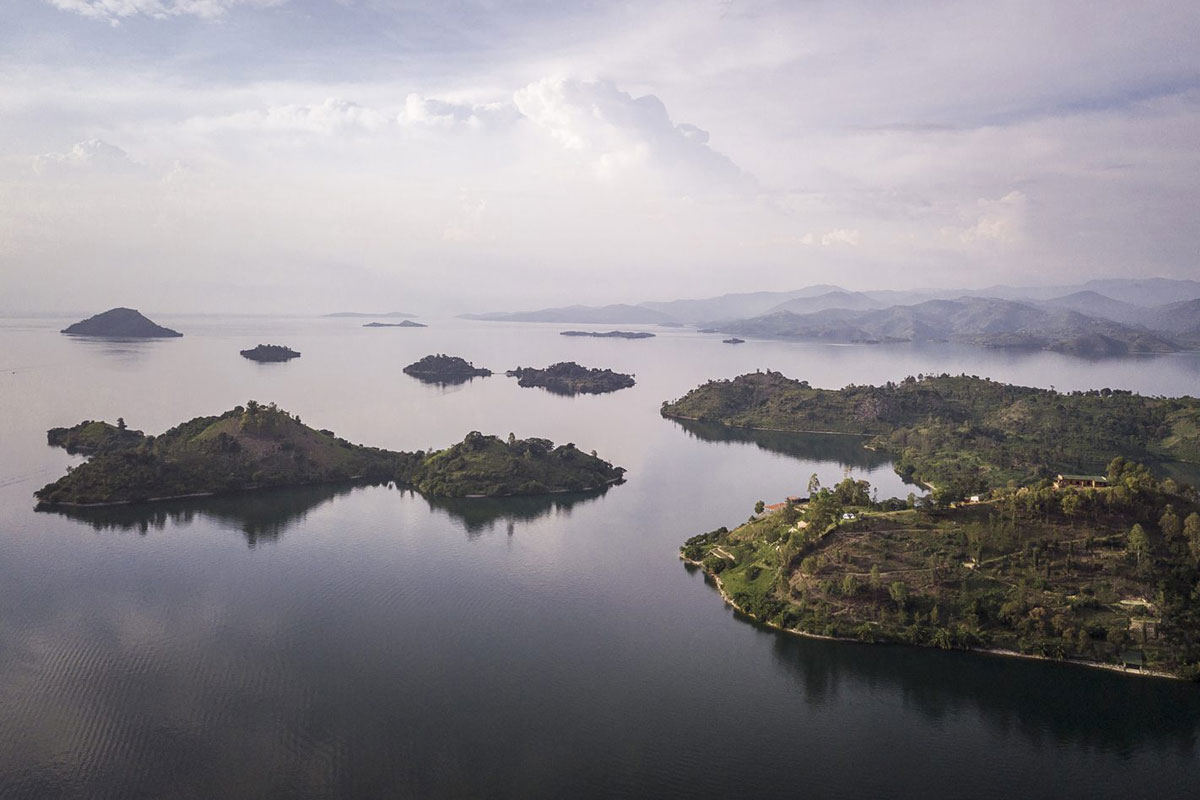
Lake Kivu is dotted with beautiful islands and is surrounded by rolling hills and lush greenery. The lake supports a wide range of aquatic life including fish species like tilapia, sardines and catfish.
With the stunning landscapes and various attractions, the lake has become a magnet for travelers seeking a blend of natural beauty, cultural experiences, and exciting adventures. Whether you’re a nature enthusiast, a cultural explorer, or an adventure seeker, Lake Kivu has something special to offer.
Lake Kivu in Rwanda
Things to do at Lake Kivu in Rwanda
1. Lakeside Retreats
The serene shores of Lake Kivu provide a picturesque backdrop for relaxation and tranquility. Numerous luxury resorts and boutique hotels dot the coastline, offering panoramic views of the lake and the surrounding hills.
Here, visitors can unwind, savor local cuisine, and indulge in spa treatments while soaking in the soothing ambiance of the lake.
2. Water Adventures – Lake Kivu in Rwanda
For the adventurous souls, Lake Kivu has several water-based activities. Kayaking, canoeing, and stand-up paddle boarding allow you to glide across the calm waters while taking in breathtaking views.
Jet skiing and speedboat rides provide an adrenaline rush, creating memorable experiences for water sports enthusiasts.
3. Cultural Encounters – Lake Kivu in Rwanda
The communities around Lake Kivu are rich in cultural diversity and heritage. You can engage in authentic interactions with local people, gaining insights into their way of life, traditions, and artistry.
Don’t miss the chance to visit vibrant local markets, where you can shop for handcrafted souvenirs and immerse yourself in the vibrant colors and flavors of East African culture.
4. Hiking – Lake Kivu in Rwanda
The hills surrounding Lake Kivu offer excellent opportunities for hiking and trekking. Trails wind through lush forests, providing glimpses of wildlife and bird species.
One of the notable hikes is the Congo Nile Trail, which stretches along the lake’s edge and offers captivating views at every turn.
5. Hot Springs and Geothermal Baths
Geothermal activity at Lake Kivu in Rwanda has given rise to natural hot springs. These therapeutic springs offer a unique way to relax and rejuvenate.
Gisenyi, a town on the Rwandan side of the lake, is famous for its lakeside hot springs, where visitors can soak in warm mineral-rich waters amidst breathtaking scenery.
6. Explore Islands
Lake Kivu in Rwanda boasts a number of islands that add an air of mystery to the region. Idjwi Island, the lake’s largest island, is known for its isolated communities, vibrant culture, and lush landscapes.
A visit to these islands offers a glimpse into traditional ways of life and provides opportunities for cultural exchanges.
7. Culinary Adventures
Exploring the culinary scene around Lake Kivu in Rwanda is a treat for the senses. Both Rwanda and the DRC contribute to a diverse food experience, with local dishes featuring fresh fish from the lake, tropical fruits, and vibrant spices.
Be sure to sample the delectable offerings at lakeside restaurants and street food stalls.
8. Birdwatching
Lake Kivu in Rwanda is a haven for bird enthusiasts. Its diverse ecosystem supports over 400 bird species, making it a prime location for birdwatching.
From the graceful African fish eagle to colorful sunbirds and elusive shoebills, the region is a bird paradise.
Where to stay near Lake Kivu
Gisenyi
Gisenyi is a large town spread over several hills on the northern edge of Lake Kivu. Once a colonial beach resort, Gisenyi’s waterfront is lined with fading old mansions, some decent hotels, and trendy bars on the lakeshore ideal for a sundowner cocktail.
Its sandy beaches and soothing thermal springs provide an ideal setting for unwinding and soaking up the stunning lake views.
Kibuye
Kibuye is probably the prettiest of Lake Kivu’s towns. It is located about 100km south of Gisenyi surrounded by hills covered in eucalyptus and pine.
Most of Kibuye’s hotels are in beautiful locations overlooking the lake and facing the sunset.
If you’re visiting in August, you may catch thousands of yellow-billed kites here flying over Lake Kivu on their annual migration.
Cyangugu
At the southern end of Lake Kivu is Cyangugu, an old border town whose fading facade tell of its past as a vital trading gateway.
It makes for a convenient base if you want to combine a stay on Lake Kivu with a Chimp tour in Nyungwe Forest National Park, which is only 45 minutes away.
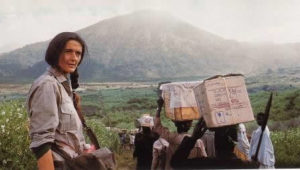
The Volcanoes National Park Rwanda also known as Parc National de Volcans (PNV) is a hub for some of the best tourism activities in Rwanda. The park itself is located in the Northern Province of Rwanda and sits on an area covering 160 Sq Km. The Volcanoes National Park was turned into a major plant and wildlife conservation areas in the early 1920’s at the same time as the Virunga National Park in the Democratic Republic of Congo and the Mgahinga National Park in Uganda. The three parks together form what is known as the Virunga conservation region for the main purpose of protecting the endangered mountain gorillas. The arrival of Dian Fossey in the park in 1967 and establishment of the Karisoke Research Center brought more publicity to the park and led to the reduction of severe poaching. Her efforts attracted greater funding for gorilla conservation programmes and ensured the survival of the giant apes.
The Volcanoes National park Rwanda has been made famous because of the endangered mountain gorillas but the mountainous landscape, green forests, lakes, rivers and a sizeable population of other wildlife also makes the park stand out. Four major volcanoes can be found in the Volcanoes National Park Rwanda. They include Bisoke (3,711m), Karisimbi (4,507m), Gahinga (3,474m), Sabyinyo (3,634m) and Muhabura (4,127m). Because of the high altitudes, volcanoes and low laying areas, the park has four types of vegetation cover consisting of Bamboo on the lower slopes, Hypericum / Hagenia on the higher altitudes below 3,300m, sub-alpine vegetation at altitudes above 3,300m and Afro alpine vegetation above 4,000m.
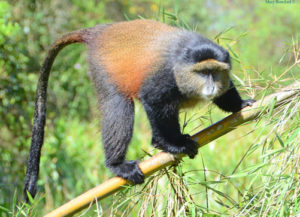
Apart from hosting 30% of the remaining population of mountain gorillas that feed on bamboo shoots and other lower altitude vegetation cover, another endangered species inhabiting the parks lower altitudes are the beautiful golden monkeys. There are also clans of wild chimpanzees and other small primates that call the park home. Larger mammals like forest Elephants and Buffaloes can be found but in small groups. The park has leopards, Duikers, Bush Pigs, Forest Hogs and the Spotted Hyena. Birding in the volcanoes national park is increasingly becoming popular in the park considering the numerous species found in the park, top of which are the beautiful Francolins and the Rwenzori Turaco.
Attractions in Volcanoes National Park Rwanda
Although gorilla trekking is the dominant activity in the volcanoes national park, there are several other incredible activities to choose from for potential visitors. Visitors may be spoiled for choice and wish they had more time to complete all the activities in the Volcanoes National Park Rwanda. The major attractions include gorilla trekking, golden monkey trekking, visiting the grave of Dian Fossey, mountain hiking, touring the lakes Ruhondo and Burera. Let’s look at the activities in more detail.
Volcanoes National Park Rwanda
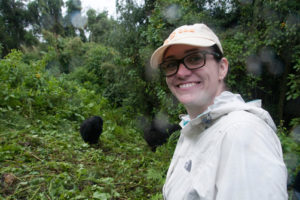
Mountain Gorilla Tracking: The Volcanoes National Park is one of the 4 national parks where mountain gorillas can be sighted. The others are Virunga in Congo, Mgahinga and Bwindi in Uganda. Their is a high chance of seeing gorillas in Mgahinga. 10 habituated Rwanda gorilla groups are available for tracking under the guidance of experienced and motivated rangers. It is important to be in good shape before embarking on an activity that can prove demanding depending on the gorilla group you are assigned. Trackers can hire the services of a porter to help with extra luggage at a cost of about $15. Read our article about gorilla trekking for the disabled for more about porters. A gorilla permits in Rwanda cost $1500 with part of it going to the local communities and infrastructural developments around the park. The Permits can be obtained directly from the Rwanda Development Board or more conveniently through the services of a tour operator. The dress code during gorilla trekking consists of long sleeve shirts and trousers, hand gloves, rain jackets and hiking shoes.
Golden Monkey Safari Rwanda
Tracking Golden monkeys: Tracking golden monkeys has gained popularity over the years and is now second only to watching the gorillas. Spotting the endangered monkeys feed, groom and swing from one bamboo tree to another costs $100. A group can consist of nearly 100 individuals and is usually led by a dominant male. Golden Monkey tracking can be done before or after gorilla trekking. Tracking the Golden Monkeys is less strenuous than the gorillas because they don’t go to high altitudes in search of fresh food like the gorillas. They prefer to feed on the Bamboo shoots that grow at the base of the volcanoes. Golden monkey permits don’t need to be booked in advance like that of the gorillas but we recommended early booking just in case.
Volcanoes National Park Rwanda
Visiting the Tomb of Dian Fossey: Dian Fossey is one of the greatest primatologists of all time. Because of her courage and determination, poaching of animals and particularly mountain gorillas was greatly reduced in the Volcanoes National Park. Without her efforts, mountain gorillas would probably be extinct by now. She is also credited for introducing new ways of making gorillas comfortable around human presence by imitating their sounds and gaining the acceptance/trust of the dominant male. Today hundreds of visitors go to pay homage to this great conservationist by visiting her grave and former Karisoke Research Center located between Mount Karisimbi and Mount Bisoke. The guided hike lasts about 3 hours and costs $75. As one climbs the volcanoes to her former base, they will get to experience what she had to go through, her determination and the passion she had for the gorillas.
Hiking Mount Karisimbi Volcano: Mount Karisimbi is an extinct Volcano that reaches a height of about 4,507m. Hiking Mount Karisimbi is one of the top tourist attractions in Musanze. It is the fifth highest in Africa and thus requires mental and physical preparation in order to ensure the 2 day hike. The hike involves navigating through thick forests before stopping at an altitude of 3700m for the first stop, rest and overnight. Hikers than continue hiking the last steep section early in the morning and up to the top of the summit. The summit rewards hikers with great views of the Volcanoes National Park, the whitened snow-capped Rwenzori Mountains, Mount Nyiragongo and all the volcanoes within the Virunga region.
Mount Bisoke Hike:Mount Bisoke is an extinct Vocano that forms part of the wider Virunga range of Mountains. It takes 3 hours of driving to reach the foot of the mountain from the capital Kigali. Hiking mount Bisoke takes one day and is relatively easier compared to Karisimbi. However, hikers still need to be reasonably fit to complete the activity. The hiking permit costs $75 and like all activities in the park, everything starts with briefing at the park headquarters before heading out to the starting point. The roads from the park headquarters to the head trail can be muddy with stones and requires a four wheel drive car. For those with heavy luggage, porters are available for hire at a cost of about $15 at the starting point.
Mount Muhabura Hike: Mount Muhabura is one of the most interesting and adventurous volcanoes to climb while visiting the Volcanoes National Park. At 4,127m, it is the third highest mountain within the Virunga ranges. The hike starts at a height of 1200m and by the time one reaches the summit, they would have passed through beautiful green forests and marveled at the other volcanoes within the wider Virunga region.